www.ems.psu.edu wrote: Let’s establish why there is a greenhouse effect.
- The surface of the Earth is warmer than it would be in the absence of an atmosphere because it receives energy from two sources: the Sun and the atmosphere.
- The atmosphere emits radiation for the same reason the Sun does: each has a finite temperature. So, just as one would be warmer by sitting beside two fireplaces than one would have been if one fireplace were extinguished, so, one is warmer by receiving radiation from both the Sun and the atmosphere than one would be if there were no atmosphere.
- Curiously, the surface of the Earth receives nearly twice as much energy from the atmosphere as it does from the Sun. Even though the Sun is much hotter, it does not cover nearly as much of the sky as does the atmosphere. A great deal of radiation coming from the direction of the Sun does not add up to as much energy as does the smaller portion of radiation emitted by each portion of the atmosphere but now coming from the whole sky. (It would take about 90,000 Suns to paper over the whole sky).
- So, it isn't even as if our atmosphere had only a minor influence on the surface temperature; it has a profound one. In the absence of an atmosphere the Earth would average about 30 Celsius degrees (about 50 Fahrenheit degrees) lower than it does at present. Life (as we now know it) could not exist.
Okay, so there are two (2) primary sources of heat, the sun and Earths atmosphere.
But what heats up the atmosphere?
Seems obvious doesn't it? The sun, right?
Well, it isn't as obvious as that.
The reflected light of the sun (light reflected off water and especially of the ICE) heats our atmosphere.
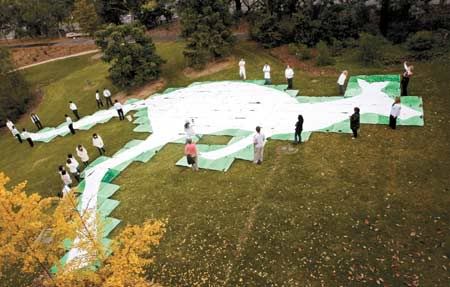
So what's this got to do with "Space Kangaroos and Global Warming"

According to yesterday's issue of a China Post article:
In other words,
"And the point of that was to make people aware that reflected light, or lack of reflected light, has a very big effect on climate."
Scientists are concerned that the melting of the polar ice caps, happening at a faster rate than expected, is quickly robbing the earth of some of the vast white spaces which have traditionally reflected the sun's rays, she said.
"If something is white it reflects a lot of light, if something is dark it absorbs it, and that will affect the temperature of our atmosphere," Vickers-Rich said.
"If we reflect less of the sun's energy and we absorb it, then our temperatures will rise. And they are rising, there's no doubt about it."
Take care of the earth
- -or-
- THE KITTY GETS IT