Page 1 of 1
A Question About Particle Accelerators
Posted: Tue Feb 05, 2008 7:25 pm
by JacksColon
Okay, so here's my question:
How do these big machines that are capable of creating great explosions of energy with temperatures reaching 100,000 times hotter than the sun able to do so without melting? haha it seems like a stupid question, but they routinely do this, and if something is that hot, it must melt shit around it!

Re: A Question About Particle Accelerators
Posted: Tue Feb 05, 2008 8:03 pm
by chickenfeather
It probably has something to do with how long they can sustain those temperatures. If it is a few nanoseconds, then cooling shouldn't be too big a deal(not to say it doesn't get really hot). It's kinda like how you can wave your hand through a fire really fast and not get burned.
Re: A Question About Particle Accelerators
Posted: Tue Feb 05, 2008 8:08 pm
by JacksColon
I suppose..but, i mean, at temps 100,000x greater than the sun, it still seems weird to me haha
Re: A Question About Particle Accelerators
Posted: Tue Feb 05, 2008 8:11 pm
by Stress
Apart from the argument above... maybe the mass of the particles is so small, that the heat they generate simply disperses before it can make itself felt.
Re: A Question About Particle Accelerators
Posted: Tue Feb 05, 2008 8:12 pm
by JacksColon
hmm, that can make some sense on some level...a lot of the time they are dealing with up and down quarks whose are esentially massless. Well, not really but, on these scales, they might as well be.
Re: A Question About Particle Accelerators
Posted: Tue Feb 05, 2008 8:18 pm
by Stress
E = mc2 ... when you have an essentially massless object, the energy doesn't get too big either, doesn't it?

Note that at my age of 15 I do not fully understand Einstein's formula. I can't figure out a physical, practical application. All I said above was because it sort of made sense to me that an object with small mass can't hold an awful lot of energy, and the formula appeared to contain a link between the two.
Re: A Question About Particle Accelerators
Posted: Tue Feb 05, 2008 9:54 pm
by crazyskwrls
i just learned about it in chem, a tokamak is used to heat up the tritium and hydrogen to 3,000,000k and fusion begins. can only sustain for like 5 seconds. it use strong magnetic field to contain the heat and it is HUGE
Re: A Question About Particle Accelerators
Posted: Tue Feb 05, 2008 10:13 pm
by PileOfMush
Stress wrote:Apart from the argument above... maybe the mass of the particles is so small, that the heat they generate simply disperses before it can make itself felt.
You get a (:::) for giving the correct answer!
Re: A Question About Particle Accelerators
Posted: Tue Feb 05, 2008 11:53 pm
by Morgoth
yes as said before, it probably uses an extremely powerful magnetic field to keep the hot stuff from touching the machine
Re: A Question About Particle Accelerators
Posted: Wed Feb 06, 2008 1:42 am
by FireJammerXR
tritium=hydrogen
Re: A Question About Particle Accelerators
Posted: Wed Feb 06, 2008 1:44 am
by Silver0
Portable Plasma Coffee Mug
Re: A Question About Particle Accelerators
Posted: Wed Feb 06, 2008 1:53 am
by StealMySoda
FireJammerXR wrote:tritium=hydrogen
No. Its an isotope of hydrogen with 2 neutrons rather than 0.
Re: A Question About Particle Accelerators
Posted: Wed Feb 06, 2008 1:57 am
by 123noob
the reason why the container aren't melting because there is generally no activity or very activity in there that doesn't generate heat that much. Unless when a trigger activates those activities (molecules bumbing into one another) that is when things get crazy.
Re: A Question About Particle Accelerators
Posted: Wed Feb 06, 2008 3:16 am
by Rainigul
Someone alert Doctor Octavius, his secret plan is getting out...
I believe it has to do with the mass of the object, if it was a few times larger, it could potentially self sustain itself (No, I'm not getting that from spiderman, I learnt alittle bit about it, but I don't like my science teacher, so I wasn't really paying attention)
Re: A Question About Particle Accelerators
Posted: Wed Feb 06, 2008 10:43 pm
by agent420
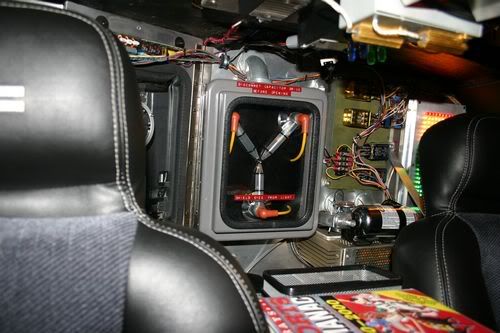
how hot is 1.21 gigawatts of electricity??? thats what it takes to run my flux capacitor!!!
Re: A Question About Particle Accelerators
Posted: Wed Feb 06, 2008 10:51 pm
by Stress
StealMySoda wrote:FireJammerXR wrote:tritium=hydrogen
No. Its an isotope of hydrogen with 2 neutrons rather than 0.
Yes. That's correct.
Deuterium = Isotope of hydrogen with 1 neutron rather than 0. D20 = Heavy Water, used with fission nuclear reactors.
Tritium = Isotope of hydrogen with 2 neutrons rather than 0. T20 = Super Heavy Water, probably used with future fusion nuclear reactors.
I hope I remembered my facts correctly
Re: A Question About Particle Accelerators
Posted: Thu Feb 07, 2008 2:18 am
by toastedsock
Particle accelerators are the devil and use dark magic to contain the highly explosive energies. It's all a government plot to keep us from developing a mega death ray that could destroy the commies. Just by mentioning the words particle accelerator you have been marked for death by a secret organization of ninja pirate demon monkeys.
Re: A Question About Particle Accelerators
Posted: Thu Feb 07, 2008 2:22 am
by XemnasXD
agent420 wrote:how hot is 1.21 gigawatts of electricity??? thats what it takes to run my flux capacitor!!!
ahhhh beat me to it....
Re: A Question About Particle Accelerators
Posted: Thu Feb 07, 2008 6:55 pm
by Valkasdar
JacksColon wrote:Okay, so here's my question:
How do these big machines that are capable of creating great explosions of energy with temperatures reaching 100,000 times hotter than the sun able to do so without melting? haha it seems like a stupid question, but they routinely do this, and if something is that hot, it must melt shit around it!
I dont know nothing about them but with simple logic I can say they got some very good coolers

yes they do reach those temps but the coolers maybe keep the surface enough cool to not melt...

and maybe use graphite for the insides surface or some sort of this :O dunno
Re: A Question About Particle Accelerators
Posted: Thu Feb 14, 2008 7:02 am
by cuchulainn
Basically the way these things work is:
They have a huge (many kilometers) circular construct where everything takes place. They use "beams" of particles such as protons that are accelerated to extremely high velocities reaching a huge amount of energy. Since protons have a charge, they can be steered using electric and magnetic fields. These have to be tuned very precisely in order to keep the beams from hitting the walls of the accelerator because at the energy levels required in the experiments they are conducting, if the beam were to become uncontrolled it would be catastrophic and damage the machine and delay further experiments for years.
The Large Hadron Collider (LHC) is the particle accelerator that has been in the news lately. It's the one that's scheduled to come online in the next year or so. They have a couple of different points on the path of the accelerator that they have detectors for their experiments. The beams are sent around and around and at certain points, they are deliberately made to cross so that there is some collision of particles. Head on collisions aren't too frequent, but there are many glancing hits. The head on collisions are the ones that give very good data.
In chemistry class, you may have heard of the "Law of Conservation of Mass" where you could neither create nor destroy matter. However, in particle physics, it's more correctly the "Law of Conservation of Mass-Energy" where Einstein's famous, e=mc^2 equation is the bridge from mass to energy and vice versa. Essentially, they are hoping for some very very very very high energy collisions between protons that would have tons of energy which (if they're lucky) will create some new particles that have been theorized to exist such as the Higgs Boson. The LHC greatly surpasses the energy levels of previous accelerators and they are hoping this increase in energy results in some new findings.
My physics professor keeps going on about how "it's an exciting time for particle physics" and if they end up finding something new and cool, he's definitely right XD
Re: A Question About Particle Accelerators
Posted: Thu Feb 14, 2008 1:54 pm
by Stress
Thanks for the info, chuch
Good to know.
Re: A Question About Particle Accelerators
Posted: Thu Feb 14, 2008 3:15 pm
by Sharasss
Yea, and I've heard some rumours from one Russian professor, that when particles collide at nearly the speed of light, a Time Hole can be created by accident, though for only a few ps (1*10^-15 seconds) or so, and you can travel in time
(LOL, he is INSANE!!)
I wish I could see the Collide sometime... One should be launched a few weeks after this post in Geneva, heard it from my Physics teach.